
CLIC is ready to be built
- CLIC baseline – a drive-beam based machine with an initial stage at 380 GeV
- The CTF3 (CLIC Test Facility at CERN) programme addressed all drive-beam production issues
- Accelerating gradient at ~100 MV/m demonstrated in numerous prototypes
- Other critical technical systems (alignment, damping rings, beam delivery, etc.) addressed via design and/or test-facility demonstrations
- A klystron-based CLIC machine is also an option for 380 GeV – hardware demonstrated in accelerating-structure test stands
- Two C-band XFELS (SACLA and SwissFEL) now operational: large-scale demonstrations of normal-conducting, high-frequency, low-emittance linacs
CLIC at 380 GeV
- CLIC high gradient technology allows for a compact accelerator
- 11 km total length ~LHC diameter, interaction region on CERN premises
- Proposed site geology well understood and extremely stable
- High luminosity: 1.5×1034 cm-2 s-1
- The CLIC design attempts to minimise use of power and cost
- Ongoing technical studies (accelerating structures, RF system, magnets, …) will allow further reduction of power and cost while maintaining overall performance
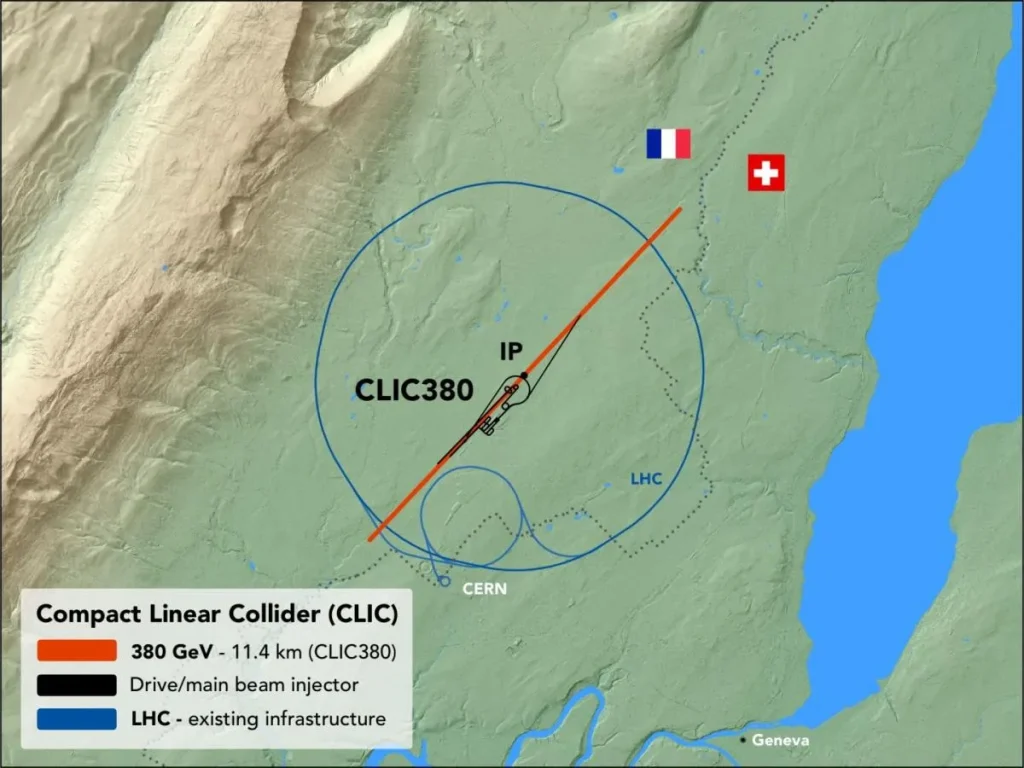
The footprint of CLIC at 380 GeV incl. drive and main beam complex
Excellent coverage of the Standard Model
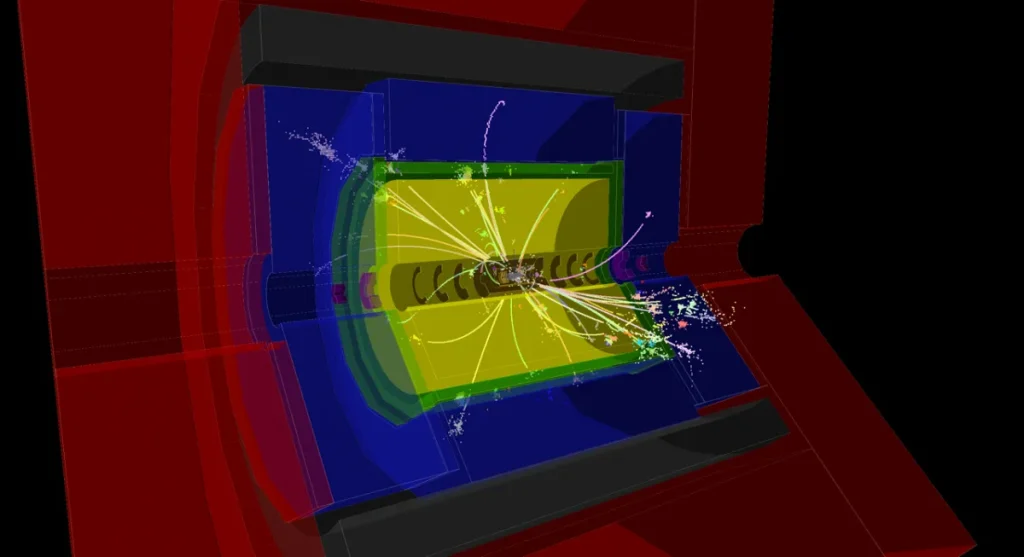
- The physics programme of CLIC at 380 GeV provides excellent coverage of the Standard Model of particle physics
- The centre-of-mass energy of the first CLIC stage was recently changed to 380 GeV to maximise the potential for precision measurements of both the Higgs boson and the top quark:
- Two different Higgs boson production modes: our overall knowledge of the Higgs boson is enhanced by measuring Higgsstrahlung and WW-boson fusion processes together
- A large number of top quark pairs are produced at the same time; these have never previously been studied in electron-positron collisions
- The Higgs and top quark coupling strengths to the other Standard Model particles can be determined with very high precision – sensitive to a wide range of phenomena beyond the Standard Model
- Beyond Higgs and top physics, CLIC allows to perform many other precision measurements at 380 GeV, with expected precisions far exceeding the LEP results
A simulated top-quark pair at 380 GeV
CLIC could be expanded to above 3 TeV with novel technologies
- 100 MV/m can be achieved with CLIC X-band technology – with this technique a centre-of-mass energy of 3 TeV can be reached
- Novel accelerating technology, including plasma wakefield and dielectric accelerators, have recently demonstrated accelerating gradients largely exceeding 100 MV/m
- The CLIC project studies whether novel technologies could be used to expand the energy range of a CLIC machine to reach collisions at 10 TeV or higher
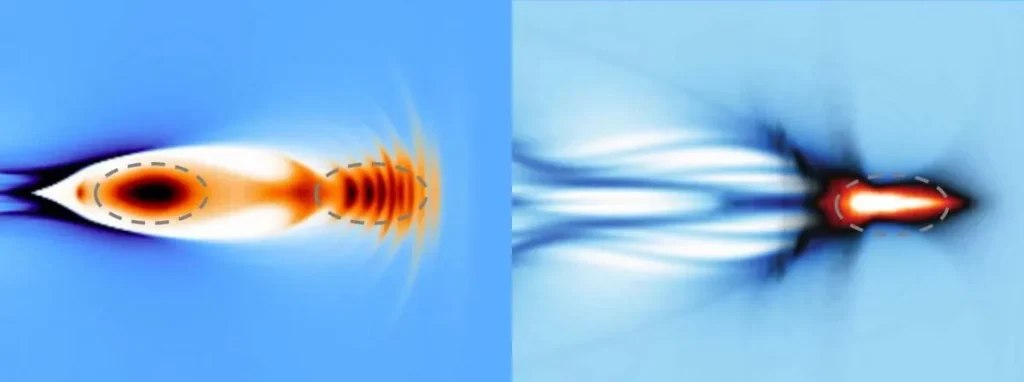
Image credit: W. An/UCLA 2015
CLIC power consumption
- Power and energy consumption at 380 GeV is well within the existing parameters and installations at CERN
- Substantial development work is focused on:
- improving efficiency of the RF systems (high efficiency klystrons and modulators)
- reducing magnet power (e.g. by using permanent magnets)
- minimising overheads for auxiliary systems
- At 1.5 TeV the energy consumption will surpass the current CERN usage (2017) by ~30%
- Normal conducting – significant potential for reduced energy costs by operation in off peak periods
- At 3 TeV the energy consumption will be a factor two of the current CERN usage (2017).
- Beyond the on-going studies mentioned above, further reduction might be needed at the 1.5 and 3 TeV stages (e.g. by reducing yearly operation from 8 to 6 months)
CLIC high-gradient applications
- Inspired by the progress made in CLIC high-gradient technology, a growing number of projects are planning to use high-gradient and/or X-band technology:
- Compact linacs and advanced diagnostics for photon sources (XFEL and Compton)
- Medical applications (proton acceleration and very high energy electron therapy)
- Linacs to test advanced acceleration technique
- Motivations include:
- higher performance (energy, repetition rate)
- lower cost (length, stored energy, efficiency)
- integration (energy upgrades to existing linacs)
CLIC technology R&D continues at CLEAR
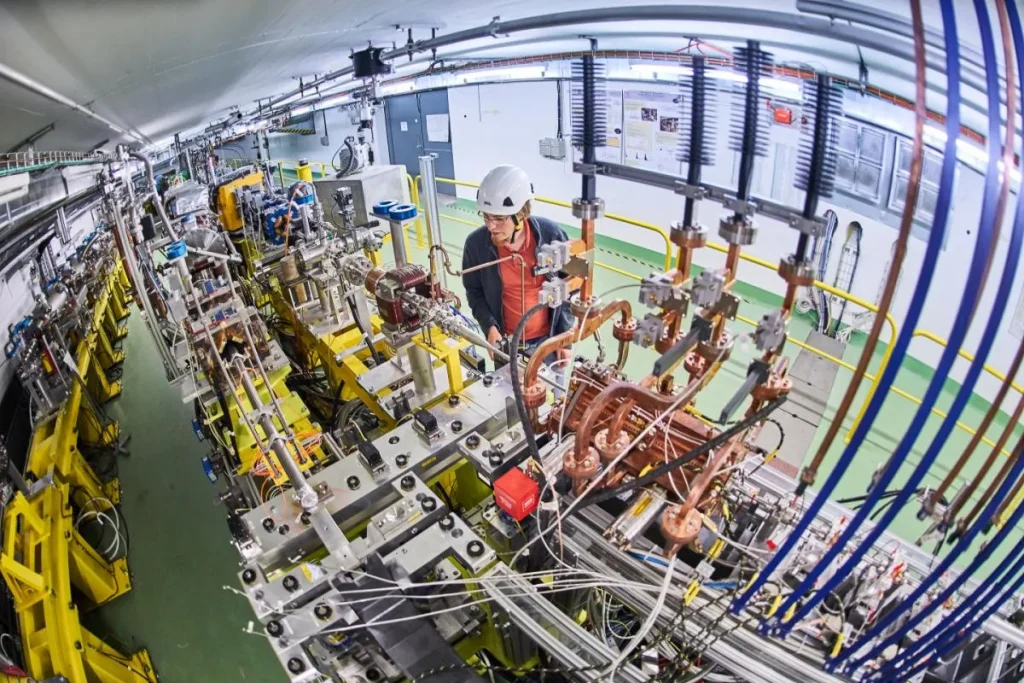
- The CLIC Test Facility at CERN (CTF3) has successfully demonstrated the CLIC key concepts – now converted into a general purpose accelerator R&D facility:
- The CERN Linear Electron Accelerator for Research (CLEAR)
- At CLEAR, CLIC foresees the continuation of Wake Field Monitor (WFM) studies and cavity BPMs (Beam Position Monitor) prototyping to allow un-precedented beam-based alignment (micrometre level) and beam orbit control
- With the experience gained from X-band technology and with the combined complementary effort at the XBOX test facilities at CERN, CLEAR aims to carry on X-band accelerating and deflecting structure tests and characterisation specific for CLIC and other projects
The CERN Linear Electron Accelerator for Research (CLEAR)